How to Buy Fabric Online in 2026 Without Getting the Wrong Weight, Stretch or Colour
Buying fabric online makes it easier to compare materials, patterns and textures without visiting multiple stores. However, a beautiful product photo does not always reveal how a fabric feels, stretches, drapes or looks in natural light. Choosing the wrong weight can affect the fit of a garment, while unexpected stretch or colour differences can change the final result.
If you are planning to sew a dress, create everyday outfits or start a DIY project, understanding fabric specifications before placing an order can save time and money. This guide explains how to buy fabric online in 2026, covering GSM, fabric composition, stretch percentage, colour accuracy, swatches and other important details to check before purchasing.
Quick Overview
- Check fabric weight to understand its thickness, structure and drape.
- Read the fabric composition label to identify fibres and their properties.
- Review stretch percentage and fabric recovery before choosing a material.
- Compare product photos with colour descriptions and customer reviews.
- Order fabric swatches before buying large quantities.
- Check return policies, fabric width and care instructions before checkout.
Why Buying Fabric Online Requires a Closer Look
Shopping for fabric online offers plenty of variety, but choosing the right material requires more than looking at attractive product images. Two fabrics may have similar colours and patterns but behave very differently when stitched.
For example, lightweight cotton voile works well for airy summer clothing, while heavier cotton twill provides more structure for trousers, jackets and utility garments. Similarly, a fabric containing elastane may offer flexibility, whereas pure cotton generally has little natural stretch.
The key is to understand the technical details listed on the product page. Retailers such as Mood Fabrics provide fabric listings that help shoppers compare different materials, compositions and specifications before making a purchase.
1. Check Fabric Weight Before Choosing a Material
Fabric weight affects how a garment hangs, feels and performs. A lightweight material may create a soft, flowing silhouette, while a heavyweight option offers more structure and durability.
Before ordering, check the weight mentioned in the product description. Two commonly used measurements are GSM (grams per square metre) and ounces per square yard (oz/yd²).
Fabric Weight GSM vs Oz Explained
GSM measures the weight of one square metre of fabric, while ounces per square yard measure the weight of one square yard. Both measurements help shoppers compare fabric thickness and weight.
For quick reference:
- Lightweight fabrics: Often suitable for scarves, summer tops and flowing dresses.
- Medium-weight fabrics: Commonly used for shirts, skirts and everyday garments.
- Heavyweight fabrics: Suitable for denim, upholstery, structured jackets and trousers.
Remember that weight alone does not determine thickness or quality. Fibre type, weave and construction also influence how a material feels and behaves.
2. Learn How to Read Fabric Content Labels
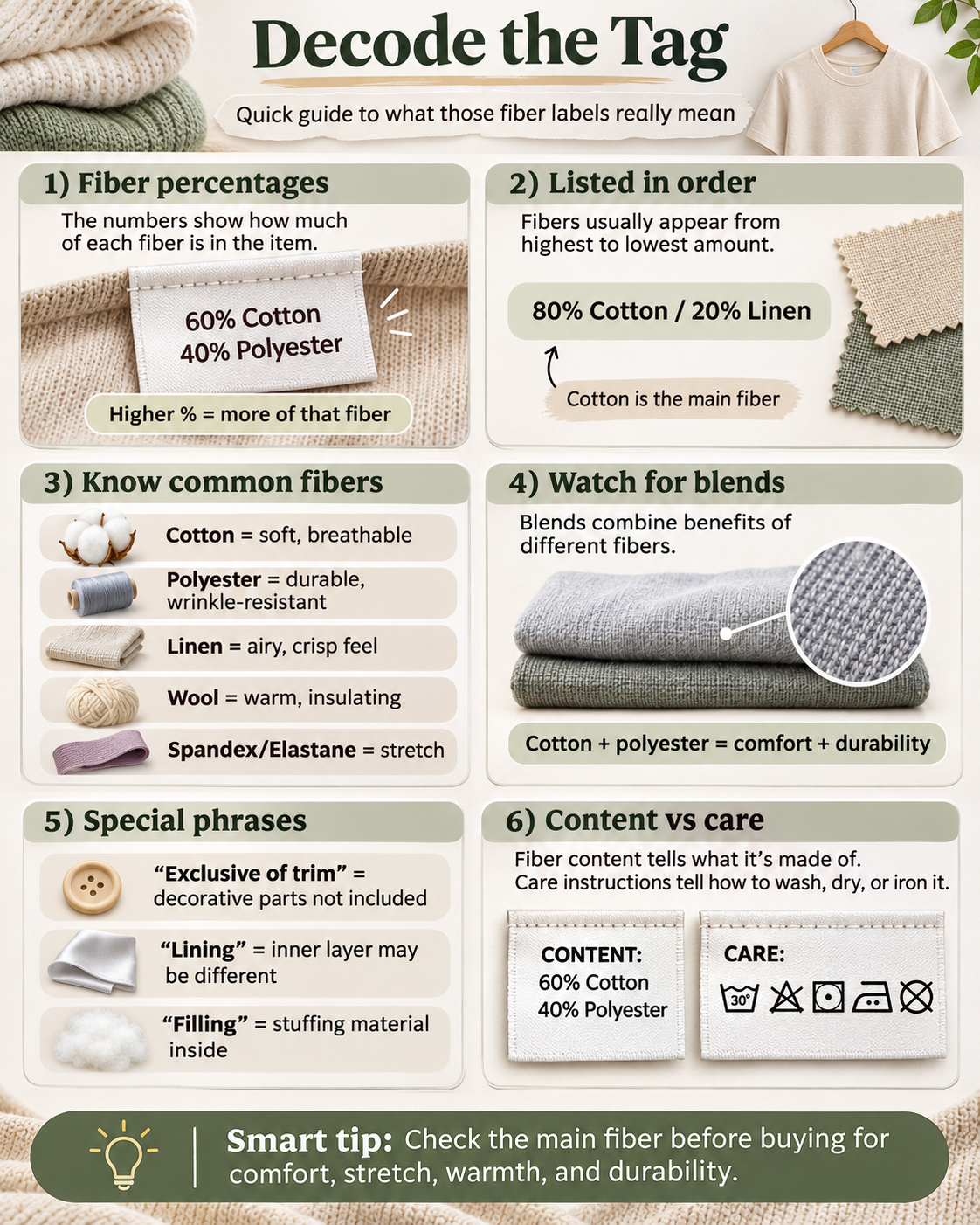
Fabric composition tells you which fibres are used to make the material. It can help you understand softness, breathability, stretch, durability and care requirements.
When learning how to read fabric content label information, pay attention to the percentage of each fibre rather than focusing only on the main fabric name.
For example:
- 100% Cotton: Generally breathable, comfortable and suitable for everyday clothing.
- Polyester: Often wrinkle-resistant, durable and quick-drying.
- Linen: Lightweight, breathable and naturally textured, although it wrinkles easily.
- Rayon/Viscose: Usually soft with a fluid drape, making it suitable for dresses and blouses.
- Cotton-Spandex Blend: Combines cotton comfort with additional flexibility.
- Wool: Offers warmth and is commonly used for winter garments and outerwear.
A fabric labelled 95% cotton and 5% elastane will behave differently from one made entirely of cotton. Always check the complete composition before selecting a material for your sewing project.
3. Understand Stretch Percentage Before Ordering
Stretch is another important factor that influences garment fit and comfort. A fabric may look smooth and flexible in a product photograph but offer very little actual stretch.
Check the product description for stretch percentage and direction. Some materials stretch horizontally, while others provide two-way or four-way stretch.
Here are a few common examples:
- No stretch: Cotton poplin and linen are generally suitable for structured garments.
- One-way stretch: Provides flexibility in one direction and works well for fitted clothing.
- Two-way stretch: Usually stretches across the width or length, depending on construction.
- Four-way stretch: Offers flexibility in both directions, making it useful for activewear, leggings and body-hugging outfits.
Also, check fabric recovery. This describes how well the material returns to its original shape after being stretched. Poor recovery can cause fitted garments to lose their shape after repeated wear.
Quick tip: If you are purchasing stretch fabric for leggings, swimwear or fitted dresses, check the recommended stretch percentage mentioned in your sewing pattern. Do not assume that every stretch fabric will provide the same flexibility.
4. Check Colour Accuracy Before Placing an Order
Colour mismatch is one of the most common concerns when shopping for fabric online. A shade that appears beige on your laptop might look slightly yellow or grey when it arrives.
Screen brightness, display calibration and lighting conditions can affect how colours appear. Product photography can also make certain shades look warmer, cooler or brighter than they are.
Before purchasing, follow these checks:
- Read the exact colour name and description.
- Look at multiple product photographs, including close-up images.
- Check whether the fabric has a glossy, matte or textured finish.
- Read customer reviews for comments about colour differences.
- Compare the shade with reference colours if you are matching an existing outfit.
Mood may also provide Pantone colour references on selected product listings. These references can help with colour comparison, although they should not replace checking the actual material.
Important: Avoid ordering large quantities based only on a screen image, especially when colour matching is essential for wedding outfits, coordinated clothing or home décor projects.
5. Order Fabric Swatches Before Buying Large Quantities
Product descriptions can explain fabric specifications, but they cannot completely communicate how a material feels in your hands. This is where physical swatches become useful.
If you are unsure about texture, colour, thickness or stretch, order fabric swatches before buying the full quantity. A small sample lets you examine the material without committing to several metres or yards.
A swatch can help you check:
- Texture: Feel whether the material is smooth, rough, soft or slightly stiff.
- Opacity: Hold it against light to understand how transparent it is.
- Drape: Fold or hang it to see how naturally it falls.
- Stretch: Gently pull it to understand its flexibility and recovery.
- Colour: Compare the actual shade under daylight and indoor lighting.
Mood also recommends ordering swatches because screen settings and different lighting conditions can affect colour appearance. Its FAQ notes that swatch sizes generally range from 5 x 6 inches to smaller cuts, depending on the material.
A sample is particularly useful when purchasing expensive materials, printed fabrics or textiles for a project that requires precise colour matching.
6. Compare Fabric Width, Yardage and Pattern Requirements
Even if you find the perfect material, ordering the wrong quantity can delay your project. Fabric width determines how much usable material you receive and how efficiently your sewing pattern can be cut.
Most online listings mention width in inches or centimetres. Common widths include 44–45 inches and 54–60 inches, although these can vary depending on the fabric.
Before adding material to your cart, consider these factors:
- Check the listed fabric width.
- Review the yardage or meterage required by your sewing pattern.
- Account for shrinkage if the fabric needs prewashing.
- Allow some extra material for cutting mistakes or pattern matching.
- Consider print repeats when working with stripes, checks or large floral designs.
For example, a large floral print may require additional fabric to align the pattern across different garment sections. Similarly, a narrow fabric width may require more yardage than a wider material for the same design.
If you are planning multiple garments or matching pieces, purchasing the required quantity together can also help reduce colour variation between separate dye lots.
7. Review Fabric Care Instructions and Return Policies
Fabric care instructions are easy to overlook when comparing materials, but they can make a significant difference to the finished garment.
Some fabrics require gentle washing, while others may need dry cleaning or special handling. Cotton and linen can shrink if they are not properly prepared, while delicate materials may require careful ironing.
Before checkout, review the following details:
- Washing and drying instructions
- Ironing temperature requirements
- Shrinkage information, if available
- Whether the material is pre-shrunk
- Return and exchange conditions
- Stock availability and estimated delivery time
Pay particular attention to return policies. Some retailers do not accept returns on cut-to-order fabrics or materials sold by the yard.
For example, Mood states that cut-to-size fabrics and trims cannot be returned or exchanged under its standard policy. This makes checking specifications and ordering swatches before purchasing especially important.
A Quick Comparison of Fabric Details to Check Before Buying
Use this table as a reference when comparing different online fabric listings.
|
Fabric detail |
What to check |
Why it matters |
|
Weight |
GSM or oz/yd² |
Helps identify the material's weight and intended use |
|
Composition |
Cotton, polyester, linen or blends |
Explains fibre properties and care needs |
|
Stretch |
One-way, two-way or four-way |
Helps determine fit and flexibility |
|
Colour |
Shade, finish and colour references |
Reduces unexpected colour differences |
|
Width |
Inches or centimetres |
Helps calculate the required quantity |
|
Texture |
Smooth, rough, soft or textured |
Gives an idea of the fabric's surface |
|
Care |
Washing, drying and ironing |
Helps maintain the material after purchase |
|
Swatches |
Sample availability |
Allows physical inspection before ordering |
8. Choose a Reliable Online Fabric Store
A good online fabric store should provide clear product descriptions, detailed photographs and useful specifications. Reliable product information makes it easier to compare materials and select something suitable for your project.
Before choosing a retailer, look for:
- Detailed fabric descriptions and composition percentages
- Accurate weight and width information
- Clear photographs showing texture and patterns
- Customer reviews and product ratings
- Swatch ordering options
- Transparent shipping and return policies
You can also compare similar fabrics across different listings to understand their specifications and prices. Mood is one option for browsing a wide selection of fashion fabrics, including cotton, linen, rayon, stretch blends and speciality textiles.
For beginners, starting with well-described fabrics and ordering small samples can make the purchasing process easier and help build confidence with future projects.
Practical Buying Fabric Online Tips for 2026
Before completing your next fabric purchase, keep these simple checks in mind:
- Start with your project: Decide whether you need fabric for a dress, trousers, upholstery or another purpose.
- Avoid vague descriptions: Look for actual weight, fibre composition and stretch details instead of relying only on words such as lightweight or premium.
- Check the weave: Understand whether the material is woven, knitted or has a special construction.
- Compare similar materials: Look at specifications from multiple sellers before making a decision.
- Keep swatches for reference: Save samples of previously purchased fabrics to compare textures and weights later.
- Calculate your quantity carefully: Follow your sewing pattern and consider additional fabric for shrinkage and matching prints.
These simple checks can help you make more informed decisions and reduce the chances of receiving material that does not suit your project.
Conclusion
Buying fabric online in 2026 can be a convenient way to find materials for sewing, fashion and creative projects. However, the right choice depends on understanding more than colour and appearance.
Check GSM, fabric composition, stretch percentage, width and care instructions before ordering. Most importantly, order swatches when you are unsure about the actual shade, texture or drape. A little research before checkout can help you avoid unnecessary purchases and choose fabric that matches your expectations.
Frequently Asked Questions
1. How to buy fabric online without choosing the wrong material?
Start by identifying your project's requirements. Check fibre composition, GSM, stretch percentage, fabric width and care instructions. Compare product photographs and descriptions, and order a swatch if you are uncertain about the material.
2. What is the difference between GSM and oz in fabric?
GSM measures fabric weight in grams per square metre, while oz/yd² measures weight in ounces per square yard. Both units indicate fabric weight and help compare materials.
3. Why should I order fabric swatches before buying?
Swatches allow you to check the actual colour, texture, opacity, stretch and drape before purchasing larger quantities. They are particularly helpful for expensive materials and projects requiring accurate colour matching.
4. How can I identify stretch fabric when shopping online?
Check the product specifications for stretch percentage, stretch direction and recovery. Look for terms such as one-way stretch, two-way stretch and four-way stretch. These details help you understand how the fabric will fit and move.
5. Which fabric details should I check before placing an online order?
Always review fabric composition, weight, width, colour, stretch, texture and care instructions. Also, check sample availability, stock information, shipping charges and return policies before completing your purchase.